
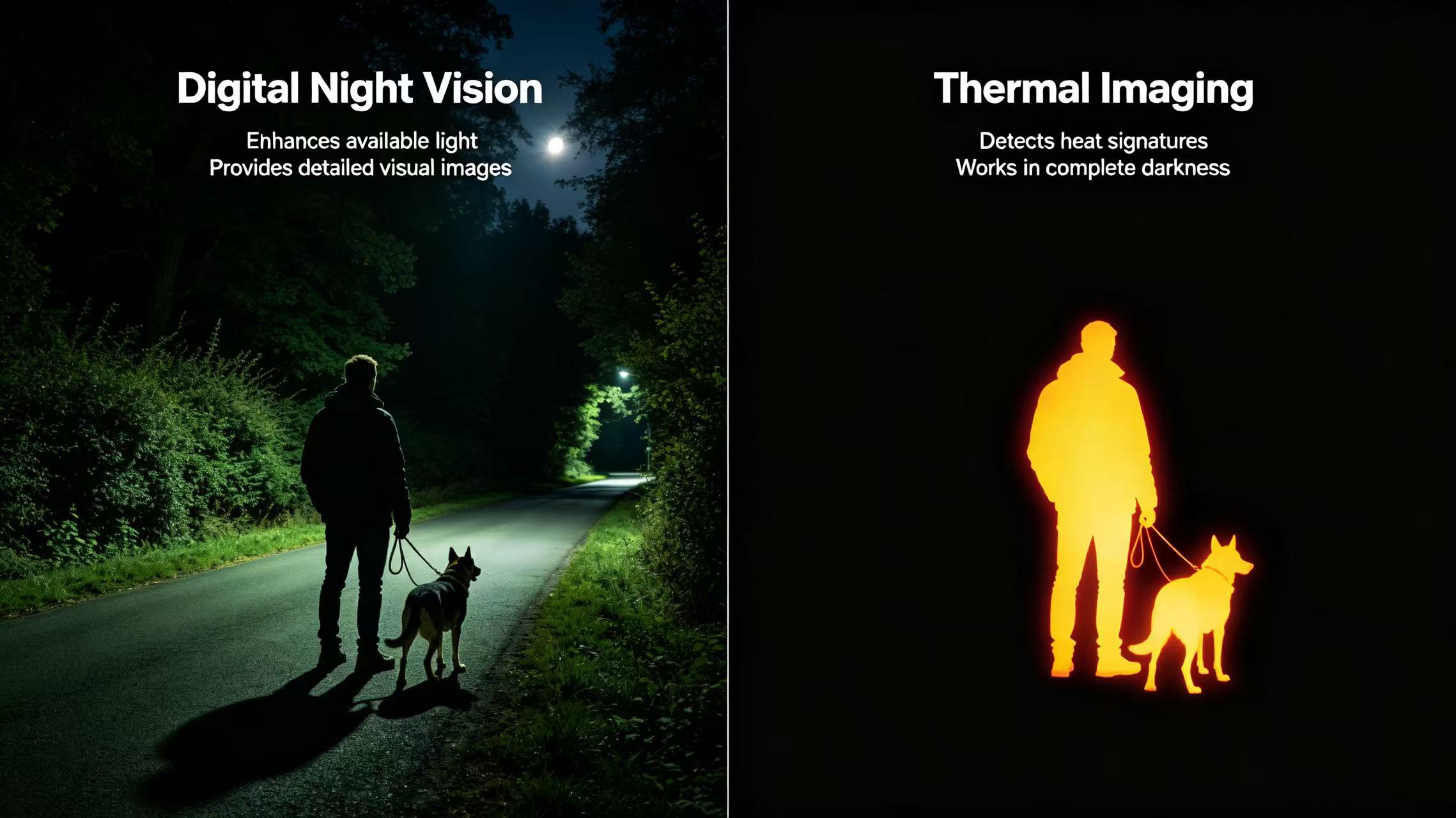
Choosing the right night vision technology can be challenging, especially when comparing digital night vision and thermal imaging.
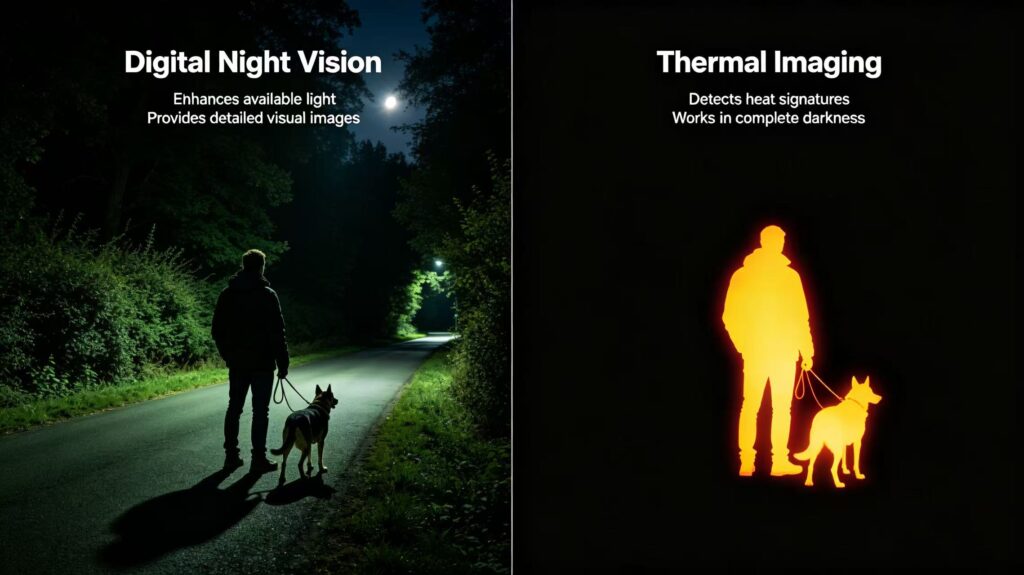
Both technologies allow users to see in low-light environments, but they work in completely different ways. Digital night vision enhances available light to create visible images, while thermal imaging detects heat signatures from objects.
Understanding the differences between night vision vs thermal imaging can help outdoor enthusiasts, professional users, and businesses choose the right night vision solution.
What is Digital Night Vision?
Digital night vision technology works by capturing ambient light through a digital sensor and enhancing the image using advanced processing. For a detailed explanation of the imaging process, read our guide on how digital night vision works.
Unlike traditional analog night vision, modern digital night vision devices use CMOS sensors to provide clear images, video recording, and additional features such as infrared illumination and full-color imaging.
Digital night vision is widely used for wildlife observation, hunting, outdoor exploration, security monitoring, and professional applications.
What is Thermal Imaging?
Thermal imaging technology works differently from digital night vision. Instead of relying on visible light, thermal cameras detect infrared radiation emitted by objects and convert temperature differences into images.
Because thermal imaging detects heat signatures, it can work in complete darkness without requiring external light sources. This makes it useful for professional applications such as search and rescue, industrial inspection, and security operations.
Night Vision vs Thermal Imaging: Key Differences
| Feature | Digital Night Vision | Thermal Imaging |
| Working Principle | Enhances available light | Detects heat signatures |
| Image Type | Real visual image | Heat-based image |
| Detail Recognition | Excellent for identifying objects | Better for detecting heat sources |
| Darkness Performance | Requires infrared illumination | Works without visible light |
| Cost | More affordable | Usually higher cost |
Which Technology is Better for Outdoor Applications?
The better technology depends on the specific outdoor application and user requirements.
Digital night vision is usually the better choice for users who need detailed visual information, such as wildlife observation, hunting, camping, and outdoor exploration. It provides a natural image that allows users to clearly recognize objects, landscapes, and surroundings.
Thermal imaging is more suitable for applications where detecting heat sources is the priority, including search and rescue, security monitoring, and professional inspections. It can detect warm objects even in complete darkness or challenging weather conditions.
For most outdoor enthusiasts and general users, digital night vision offers an excellent balance between image quality, functionality and affordability. For professional detection tasks, thermal imaging may provide additional advantages.
Why Choose a Digital Night Vision Device?
For many outdoor applications, digital night vision devices provide an excellent balance between image quality, usability, and cost.
Modern digital night vision technology allows users to capture detailed images and videos in low-light environments. Features such as infrared illumination, 4K resolution, and full-color night vision provide better viewing experiences for outdoor observation.
Compared with thermal imaging systems, digital night vision devices are often more affordable and provide a more natural image that helps users recognize objects and environments clearly.
Professional Digital Night Vision Solutions from Z.T. Digital
Z.T. Digital specializes in digital night vision devices, including 4K night vision binoculars and monocular solutions for outdoor enthusiasts, distributors, and professional users.
Our products combine advanced imaging technology, reliable performance, and OEM customization capabilities to support global brands and business partners.
Frequently Asked Questions
Can digital night vision work in complete darkness?
Digital night vision devices usually require some available light or infrared illumination to create images. With infrared illuminators, modern digital night vision devices can operate effectively in very dark environments.
Is thermal imaging better than night vision?
Thermal imaging and digital night vision serve different purposes. Thermal imaging is excellent for detecting heat sources, while digital night vision provides detailed visual images that are useful for identification and observation.
What is the best night vision device for outdoor use?
The best night vision device depends on the application. Digital night vision binoculars are suitable for wildlife observation and outdoor exploration, while monocular devices offer portability and flexibility.
Looking for Reliable Digital Night Vision Solutions?
Z.T. Digital provides professional digital night vision binoculars, monoculars, and OEM/ODM solutions for global distributors and brands.
Contact us today to discuss your customized night vision requirements.